Panama Corporation
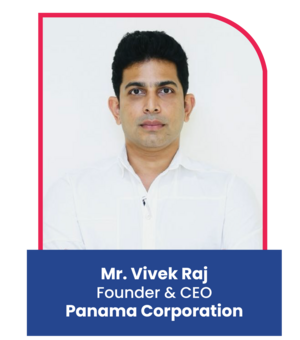
Mr. Vivek Raj
Founder & CEO, Panama Corporation
1. In today’s evolving global landscape, what does being a 'future-ready organisation' mean to you, beyond technology and digital transformation?
To me, a future-ready organisation is not defined simply by the technology it adopts, but by its ability to adapt, learn, and remain resilient in the face of uncertainty.
Over the years, I have worked across industries ranging from global trade to agriculture, and one lesson has remained constant: technology alone does not create resilience. Culture, adaptability, execution discipline, and long-term thinking do.
One experience profoundly shaped my thinking. In one of our earlier agricultural ventures, an entire crop cycle was severely impacted by environmental unpredictability. It reinforced a reality that farmers across the world face every day: despite being one of humanity's most essential sectors, agriculture remains one of its least predictable, constantly exposed to forces beyond human control.
That experience led me to question why some industries, such as semiconductor manufacturing, can achieve extraordinary levels of consistency, precision, and repeatability, while agriculture, despite being one of the world's most essential industries, continues to depend heavily on variables such as climate, environment, and intuition.
Future readiness, therefore, is about building organisations that reduce dependence on uncertainty. It is about creating systems that can sense change early, respond intelligently, and continuously improve. It requires investing in people, knowledge, innovation, and institutional memory rather than focusing solely on short-term performance metrics.
Technology is an enabler, but the true differentiator is an organisation's ability to transform disruption into opportunity. The companies that will lead the future are those that combine innovation with resilience, ambition with responsibility, and growth with long-term value creation.
2. At a time when geopolitical alliances are being reshaped, what, in your view, makes the India-France partnership particularly resilient and future-oriented?
For most of human history, food security was viewed primarily as an agricultural challenge. Today, it has become a strategic challenge. Climate volatility, geopolitical tensions, supply chain disruptions, and growing populations are forcing nations to rethink how critical resources are produced, protected, and sustained.
This is what makes the India-France partnership particularly relevant and resilient. Unlike many relationships shaped by short-term geopolitical considerations, the India-France partnership has been built on trust, strategic consistency, and a shared commitment to long-term cooperation. Both countries have demonstrated an ability to maintain independent strategic thinking while remaining deeply committed to international collaboration.
What excites me most is the complementary nature of our strengths. France brings world-class capabilities in scientific research, engineering, deep technology, industrial innovation, and sustainability. India contributes scale, entrepreneurial dynamism, digital capabilities, talent, and an increasingly innovation-driven economy. Together, we create an ecosystem capable of transforming breakthrough ideas into globally relevant solutions.
This is particularly important in sectors such as agriculture, climate resilience, advanced manufacturing, and emerging technologies, where the challenges we face increasingly transcend national boundaries. At Panama HydroX, our mission is rooted in a simple question: can agriculture become as predictable as manufacturing? We believe technologies that improve predictability, resilience, and resource efficiency will become increasingly important as nations seek to strengthen both food security and strategic self-reliance.
The India-France partnership provides a powerful platform to accelerate such innovation through stronger collaboration between researchers, entrepreneurs, industry leaders, investors, and policymakers. That combination of trust, complementary strengths, and a shared commitment to solving global challenges is what makes the relationship not only resilient, but genuinely future-oriented.
3. The India-France Year of Innovation 2026 presents a significant opportunity to deepen technological and entrepreneurial collaboration. How do you see your organisation contributing to this shared innovation agenda?
At Panama HydroX, our contribution to the India-France Year of Innovation is centred on BIOMOD™, our proprietary biological intelligence platform designed to bring manufacturing-grade precision, predictability, and scalability to agriculture. By integrating artificial intelligence, machine learning, computer vision, IoT, automation, and controlled-environment cultivation, BIOMOD™ enables real-time monitoring, optimisation, and decision-making across the crop lifecycle.
A key component of our innovation is the application of advanced neural image-processing technologies, including our Diffused Concurrent Convolution Neural Network (DCCNN) architecture for early disease detection and crop health analysis. Combined with AI-driven environmental and nutrient optimisation, these systems are designed to reduce uncertainty in biological production and transform agriculture from a reactive practice into a predictive one.
Our mission is rooted in a simple question that has fascinated me for years: can agriculture become as predictable as manufacturing? We believe this question is becoming increasingly important as climate volatility, resource constraints, supply chain disruptions, and growing populations place unprecedented pressure on global food systems.
Beyond productivity, we believe the future of food security lies in producing better food, not simply more food. For decades, agriculture has become increasingly efficient at producing calories, but not necessarily nutrition. Through highly controlled cultivation environments and intelligent biological production systems, we aim to contribute to both food security and nutritional security by enabling the consistent cultivation of high-quality crops with greater nutritional value and resource efficiency.
The India-France Year of Innovation presents a unique opportunity to accelerate this vision. France's strengths in scientific research, engineering, biotechnology, and industrial innovation complement India's strengths in technology development, entrepreneurship, and scalability. Through collaborative research, technology partnerships, pilot programmes, and knowledge exchange, we see significant opportunities to develop globally relevant solutions that strengthen food systems, improve sustainability, and build greater resilience for future generations.
The greatest measure of innovation is not what it creates for us today, but what it leaves behind for our children tomorrow.
4. How important you think are institutions like IFCCI in strengthening trust, dialogue and long-term economic partnerships?
I have always believed that some of the most important economic outcomes are impossible to measure in the moment they are created.
A conversation becomes a partnership. A partnership becomes a research collaboration. A research collaboration becomes a company. A company becomes an industry. By the time the economic impact becomes visible, most people have forgotten where it began.
That is why institutions like IFCCI are far more important today than they were a decade ago.
We are entering a world defined by geopolitical realignments, technological disruption, supply chain restructuring, and increasing competition for critical resources. In such an environment, economic relationships cannot rely solely on government-to-government engagement or commercial transactions. They require continuity, dialogue, and trust built over time.
In my view, IFCCI's greatest contribution is that it creates the conditions under which trust can develop before there is a transaction or a commercial outcome. It provides a platform where entrepreneurs, researchers, investors, policymakers, and industry leaders can engage with one another long before opportunities become visible.
As an entrepreneur, I have learned that transformative ideas rarely emerge in isolation. They emerge when different disciplines, industries, and perspectives intersect. Whether the challenge is food security, artificial intelligence, biotechnology, climate resilience, or advanced manufacturing, progress increasingly depends on our ability to connect expertise across borders.
By strengthening connections between India and France, IFCCI helps create relationships that often outlast business cycles, political administrations, and market trends. Those relationships become the foundation for future investments, research collaborations, technology partnerships, and entirely new industries.
Ultimately, the strongest economic partnerships are not built on trade alone. They are built on trust. And trust, unlike capital, compounds over time. Institutions like IFCCI play a critical role in creating that compounding effect, generating value that can endure for decades and often across generations.