J.B. BODA GROUP
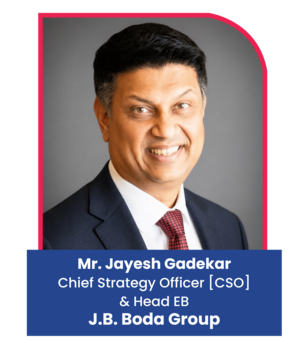
Mr. Jayesh Gadekar
Chief Strategy Officer [CSO] & Head EB, J.B. Boda Group
1. In today’s evolving global landscape, what does being a 'future-ready organisation' mean to you, beyond technology and digital transformation?
Being a future-ready organisation means much more than adopting the latest technologies or driving digital transformation. In today’s rapidly changing global environment, it is about building an organisation that is adaptable, resilient, and people-centric.
A future-ready organisation embraces a culture of continuous learning and innovation. Employees are encouraged to develop new skills, challenge traditional ways of working, and remain open to change. Such organisations invest in their people as much as they invest in technology, recognizing that human capability, creativity, and collaboration are the true drivers of long-term success.
Another critical aspect is agility. Future-ready organisations can quickly respond to market shifts, customer expectations, economic uncertainties, and emerging global trends. They foster flexible structures, empower decision-making at all levels, and encourage cross-functional collaboration to solve complex challenges effectively.
Sustainability and responsible business practices also define future readiness. Organisations today are expected to create value not only for shareholders but also for employees, customers, communities, and the environment. By integrating ethical decision-making, diversity and inclusion, and environmental responsibility into their strategy, organisations can build stronger trust and long-term relevance.
Customer-centricity is equally important. Future-ready organisations continuously listen to customer needs, anticipate changing expectations, and deliver meaningful experiences. They proactively adapt their products, services, and processes to remain competitive in an evolving marketplace.
Finally, strong leadership plays a vital role. Future-ready leaders provide a clear vision, foster resilience during uncertainty, and create an environment where people feel empowered, valued, and motivated to contribute their best.
To me, being a future-ready organisation means having the ability to evolve continuously while staying true to its purpose and values. It is an organisation that combines innovation with empathy, agility with stability, and business success with social responsibility. Such organisations are not merely prepared for the future; they actively shape it by creating sustainable value for all stakeholders and cultivating a workforce that is equipped to thrive in an ever-changing world.
2. At a time when geopolitical alliances are being reshaped, what, in your view, makes the India-France partnership particularly resilient and future-oriented?
The India-France partnership stands out as one of the most resilient and future-oriented bilateral relationships in today’s rapidly changing geopolitical environment. What makes this partnership unique is its foundation of strategic trust, mutual respect, and long-term alignment of interests, rather than short-term political or economic considerations.
One of the key strengths of the relationship is its consistency across decades. France has been a reliable partner for India in areas such as defense, security, space cooperation, and civil nuclear energy. Unlike many international partnerships that fluctuate with changing global dynamics, the India-France relationship has demonstrated continuity and stability, allowing both countries to pursue ambitious long-term goals with confidence.
Another factor contributing to its resilience is the shared commitment to strategic autonomy. Both nations value independent decision-making and support a multipolar world order that promotes balance, dialogue, and respect for sovereignty. This common outlook enables them to collaborate effectively on major global issues, including regional security, climate change, and international governance.
The partnership is also increasingly future-oriented because it extends beyond traditional sectors. India and France are expanding cooperation in emerging areas such as artificial intelligence, cybersecurity, digital innovation, renewable energy, clean technologies, and sustainable infrastructure. Their joint focus on innovation and green growth positions both countries to address future economic and environmental challenges.
The Indo-Pacific region is another important pillar of the relationship. As maritime nations with significant interests in the region, India and France share a vision of a free, open, inclusive, and rules-based Indo-Pacific. Their growing collaboration in maritime security, connectivity, and disaster resilience enhances regional stability and demonstrates their ability to address evolving global challenges together.
Perhaps most importantly, the partnership is strengthened by strong people-to-people ties, educational exchanges, cultural connections, and increasing business collaboration. These interactions create a broader foundation that extends beyond governments.
In my view, the India-France partnership is resilient because it is built on trust and shared values, and future-oriented because it continuously evolves to address new opportunities and challenges in an increasingly interconnected world.
3. The India-France Year of Innovation 2026 presents a significant opportunity to deepen technological and entrepreneurial collaboration. How do you see your organisation contributing to this shared innovation agenda?
The India-France Year of Innovation 2026 provides a valuable platform to strengthen collaboration in technology, research, entrepreneurship, and sustainable development. In my view, our organisation can contribute meaningfully to this shared innovation agenda by fostering a culture that encourages experimentation, knowledge sharing, and cross-border collaboration.
One of the most impactful ways we can contribute is by leveraging our expertise to support innovation-led projects that address real-world challenges. Whether through digital transformation initiatives, process innovation, sustainability programs, or customer-centric solutions, we can help create scalable models that generate value for businesses and society. By collaborating with French partners, startups, academic institutions, and industry experts, we can exchange best practices and accelerate the development of innovative solutions.
Talent development is another area where our organisation can play a significant role. Encouraging employee participation in joint innovation programs, hackathons, research collaborations, and skill-building initiatives can help create a workforce equipped for future challenges. Such exchanges not only strengthen technical capabilities but also promote cross-cultural learning and diverse perspectives, which are essential drivers of innovation.
Additionally, our organisation can contribute by supporting emerging technologies and sustainable practices. Areas such as artificial intelligence, data analytics, cybersecurity, green technologies, smart infrastructure, and digital services offer immense opportunities for India-France collaboration. By identifying use cases and encouraging pilot projects in these domains, we can help translate innovative ideas into practical outcomes.
Innovation today is not limited to technology alone; it is also about creating inclusive and sustainable growth. Therefore, we can contribute by ensuring that innovation initiatives are aligned with broader societal goals, including environmental responsibility, accessibility, and community impact.
Ultimately, the India-France Year of Innovation 2026 is an opportunity to build long-term partnerships, strengthen innovation ecosystems, and create shared value. Our organisation can contribute by acting as a catalyst for collaboration, nurturing talent, promoting sustainable innovation, and embracing a mindset of continuous learning. Through these efforts, we can help advance the shared vision of both nations and contribute to a more innovative, resilient, and future-ready world.
4. How important you think are institutions like IFCCI in strengthening trust, dialogue and long-term economic partnerships?
Institutions like the Indo-French Chamber of Commerce and Industry (IFCCI) play a critical role in strengthening trust, dialogue, and long-term economic partnerships between India and France. While government-to-government cooperation provides the strategic framework, organizations such as IFCCI help translate that vision into meaningful business collaborations and tangible outcomes.
One of IFCCI’s greatest contributions is its ability to act as a bridge between businesses, policymakers, entrepreneurs, academia, and industry leaders from both countries. By providing a platform for networking, knowledge exchange, and collaboration, it helps organizations identify opportunities, navigate challenges, and build relationships based on mutual trust and understanding. These connections are particularly important in today's global environment, where economic growth increasingly depends on international partnerships and innovation ecosystems.
IFCCI also plays a vital role in promoting business confidence. Through industry forums, trade delegations, policy discussions, and sector-specific initiatives, it facilitates continuous dialogue between stakeholders. This enables businesses to better understand market dynamics, regulatory environments, and emerging opportunities in both countries. Such engagement reduces barriers to collaboration and encourages long-term investment decisions.
Another important aspect is its support for innovation and talent development. By bringing together startups, established enterprises, research institutions, and young professionals, IFCCI helps foster innovation-driven partnerships. These interactions create opportunities for sharing expertise, developing new technologies, and building capabilities that benefit both economies.
Beyond business, institutions like IFCCI contribute to strengthening people-to-people connections and cultural understanding. Strong economic partnerships are often built on a foundation of trust, shared experiences, and sustained engagement. By encouraging exchanges across industries and communities, IFCCI helps create a more resilient and enduring relationship between India and France.
In my view, the importance of institutions like IFCCI extends far beyond trade promotion. They serve as catalysts for collaboration, innovation, and mutual growth. By fostering dialogue, enabling partnerships, and connecting diverse stakeholders, IFCCI plays a key role in ensuring that the India-France relationship remains dynamic, future-oriented, and capable of creating long-term value for both nations.