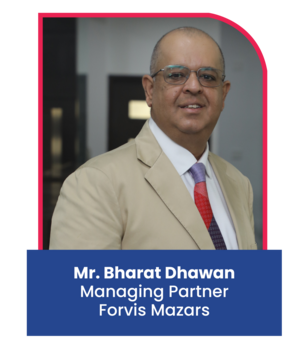
Mr. Bharat Dhawan
Managing Partner, Forvis Mazars
1. In today’s evolving global landscape, how are you building resilience and agility in your leadership strategy?
In an increasingly complex and fast-changing global environment, the focus remains on building resilience through agility, integration, and foresight. At Forvis Mazars India, we operate as an agile, globally integrated network that allows us to respond quickly to regulatory changes, market shifts, and client needs while maintaining consistency and quality. We invest deeply in industry expertise, digital capabilities, and talent development, enabling our teams to anticipate challenges rather than react to them. Equally important is our high-touch, personalized approach—staying close to clients, regulators, and industry bodies allows us to proactively shape solutions, contribute to policy discussions, and support long-term, sustainable transformation. This combination of adaptability, collaboration, and purpose-driven leadership is central to how we build resilience across the organization.
2. With sustainability and innovation now essential to business success, could you share some recent initiatives your company has undertaken in these areas?
Sustainability and innovation are deeply embedded in how we think, operate, and advise our clients. From a people and governance perspective, we continue to strengthen responsible business practices through our strong commitment to diversity, equity, and inclusion. With 50% representation of women on our Group Executive Committee and 23% among our global partners, alongside well-structured diversity, equity and inclusion (DE&I)-related initiatives, mentorship programmes, and well-being networks, we focus on building a resilient and future-ready organisation.
On the innovation front, we invest significantly in research and insight-led initiatives that help businesses navigate complexity and plan for what’s next. Our Client Listening Programme ensures we continuously adapt to evolving client needs, while our annual ESG & Sustainability Report supports organisations in driving responsible growth. We also publish several globally recognised thought-leadership reports, including the C-Suite Barometer, Global Trade Insights Tracker, and the Global Private Equity Report, which analyse market shifts, geopolitical dynamics, and investment trends. Together, these initiatives enable us to anticipate change, share actionable insights, and help clients build sustainable, competitive strategies in an increasingly dynamic global environment.
3. As a CEO, how do you view India’s role in your global growth strategy and what strategic advantages does the country offer your business or the industry you operate in?
India is a key pillar of our global growth strategy, driven by strong fundamentals in talent, technology, innovation, and infrastructure. Country’s strong focus on skill development and technology democratization, supported by national missions in future-forward areas like artificial intelligence, semiconductors, renewable energy, green Hydrogen, and space technology, creates unparalleled opportunities for investment, collaboration, and long-term value creation.
India is also at the forefront of global economic growth, offering one of the world’s largest and most dynamic consumer markets. With a population of over 1.4 billion and a rapidly expanding middle class, the country combines scale, youth, and sustained economic momentum. Growth is driven by robust domestic consumption, large-scale infrastructure development, and policy initiatives such as Make in India and the Production Linked Incentive (PLI) scheme, which have significantly enhanced India’s attractiveness as a manufacturing and supply-chain diversification hub.
From a business perspective, India benefits from a young, highly skilled workforce, competitive cost structures, and a vibrant innovation ecosystem spanning fintech, SaaS, e-mobility, clean energy, agri-tech and health-tech. Its strategic geographic location also enables seamless access to high-growth markets across Asia, the Middle East, and the Africa. Importantly, even amid global uncertainty, India continues to be a bright spot—global institutions consistently project strong growth, underpinned by resilient domestic demand, rising investments, and a stable external sector. Improvements in ease of doing business, global-level competitiveness, and enhanced efficiency of the logistics and transportation sector in the country further reinforce India’s position as a stable, growth-oriented market offering attractive and sustainable returns for global investors.
4. What is the biggest opportunity you see for Indo-French business collaboration by 2030? Please let us know how your company/organisation is preparing for it.
At Forvis Mazars in India, we believe the most significant opportunity for Indo-French business collaboration by 2030 lies in the co-creation of future-ready business ecosystems, rather than in transactional trade alone. The relationship between India and France is entering a phase where economic cooperation is increasingly shaped by shared strategic priorities—notably sustainability, innovation, and industrial transformation.
India is moving rapidly from being a cost-efficient market to becoming a global platform for innovation, manufacturing, and digital scale. On the other hand, France brings deep strengths in industrial engineering, applied research, governance frameworks, and sustainable finance. The real opportunity lies at the intersection of these capabilities: building solutions in India, with French collaboration, that are designed for global deployment whether in clean energy, advanced manufacturing, digital infrastructure, or regulated industries.
As a professional services organisation with strong Indo-French roots, our preparation for this opportunity is very deliberate. We have a dedicated French Desk operating in India, which focuses on servicing French businesses looking at the India growth story and cross-border expansion between India and Europe. Through our network firms, we are investing in cross-border advisory capabilities that help businesses navigate complexity be it regulatory alignment, ESG integration, governance, or large-scale transformation. Increasingly, our role is not just to support market entry or compliance, but to act as a strategic bridge, enabling Indian and French enterprises to collaborate across the full business lifecycle, from structuring and investment to innovation and scale-up.
By 2030, the success of Indo-French collaboration will be measured less by trade volumes and more by how effectively the two countries jointly shape resilient, sustainable, and globally competitive businesses. That is the opportunity we are preparing for and one we see as central to our own growth strategy.
5. With 2026 being celebrated as the Indo-French Year of Innovation, how do you envision this initiative creating new opportunities for growth and collaboration?
The Indo-French Year of Innovation in 2026 presents a unique opportunity to institutionalise innovation-led collaboration between the two countries rather than treating innovation as a standalone activity. We see it as a moment where India and France can align their policy priorities, industrial strengths and research capabilities to create platforms that consistently generate new business models, technologies and market opportunities. The upcoming AI Summit is an example of the collaboration that the two countries are undertaking across sectors.
At Forvis Mazars in India, we are approaching this with a strong focus on enabling execution. We are investing in advisory capabilities around innovation governance, cross-border structuring, ESG integration and capital alignment to support businesses engaging in Indo-French initiatives. We are also actively engaging with industry forums and innovation ecosystems in both countries to help our clients move from intent to implementation.
We believe the true impact of the Year of Innovation will be felt in how effectively it builds repeatable collaboration frameworks, allowing businesses to scale ideas into sustainable growth well beyond 2026.