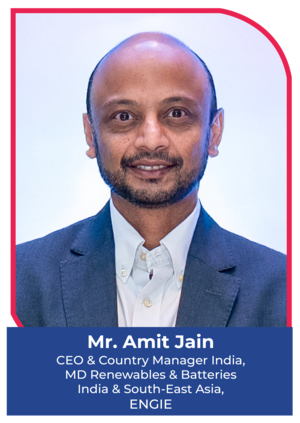
- Mr. Amit Jain - CEO & Country Manager India, MD Renewables & Batteries India & South-East Asia, ENGIE
1. What is the biggest opportunity you see for Indo-French business collaboration in the next 5 years? Please let us know how your company/organisation is preparing for it.
The Indo-French partnership is poised to play a catalytic role in accelerating the global shift to clean energy. Over the next five years, one of the most compelling opportunities lies in jointly scaling sustainable infrastructure across solar, wind, hybrid energy systems, and emerging technologies such as green hydrogen.
At ENGIE India, we are actively advancing this agenda by expanding our renewable portfolio—now at 2.3 GW across seven states—by building integrated, future-ready energy solutions that support both national priorities and global climate goals.
A key enabler of this transformation is the evolution of energy trading and market design. Through ENGIE’s Energy Management platform, we bring deep expertise in optimizing energy flows, managing market volatility, and unlocking value through flexible, low-carbon energy trading strategies. As India’s energy markets mature, our Supply & Energy Management team can play a critical role in enhancing resilience, balancing supply and demand in real time, and supporting the integration of variable renewables.
The shared commitment of India and France to sustainability, innovation, and energy equity creates a strong foundation for high-impact collaboration with global resonance.
2. In today’s evolving global landscape, how are you building resilience and agility in your leadership strategy?
In today’s dynamic business environment, resilience and agility have become more important than ever. At ENGIE, we’ve embedded both into our leadership approach through a decentralized, empowered operating model. This allows our teams to respond quickly to market signals while staying aligned with ENGIE’s global ESG and innovation objectives. We also place a strong emphasis on scenario planning, policy engagement, and cross-functional collaboration. For instance, we have been actively involved in shaping India’s energy market reforms, ensuring we remain agile in the face of regulatory shifts while contributing to a more robust and inclusive energy ecosystem.
3. With sustainability and innovation now essential to business success, could you share some recent initiatives your company has undertaken in these areas?
At ENGIE, sustainability and innovation are guiding principles for everything we do. In India, wehave deployed dry robotic cleaning technology across our solar sites to drastically reduce water usage—an important step in water-scarce regions.
We have also achieved the Sustainable Energy Transition (SET) certification, reflecting our commitment to responsible operations and long-term environmental stewardship.
On the innovation front, we’re piloting hybrid renewable systems and battery storage solutions to enhance grid flexibility and operational efficiency.
Our commitment to sustainability also extends to local ecosystems. Over 80% of our workforce is hired locally, reflecting our belief in building from within the communities we serve. We continue to invest in high-impact development programs that create long-term value on the ground.
4. With 2026 being celebrated as the Indo-French Year of Innovation, how do you envision this initiative creating new opportunities for growth and collaboration?
The Indo-French Year of Innovation in 2026 is a moment to show how collaboration can shape global growth. India has the scale, talent, and ingenuity to lead in the clean economy, and France brings complementary strengths that accelerate this momentum. Together, the opportunity is to build resilient supply chains, develop bankable projects, and equip talent for industries of the future. ENGIE is contributing to India’s energy journey by building clean power that is reliable, affordable, and globally competitive. In 2026, we are deepening this work as part of the Indo-French Year of Innovation, where collaboration is creating outcomes that position India as a hub for sustainable growth.
5. As a CEO, how do you view India’s role in your global growth strategy and what strategic advantages does the country offer your business or the industry you operate in?
India plays a pivotal role in ENGIE’s global growth strategy. The country’s ambitious renewable energy targets, progressive regulatory outlook, and deep talent pool make it an ideal landscape for scalable and innovative clean energy solutions. India offers market opportunity, as well as a strong willingness to embrace transformative models.
For ENGIE, India is a strategic innovation hub, and a launchpad for new business models and technologies that can be replicated across other geographies. The speed of policy shifts, demand evolution, and digital adoption makes it an ideal ground to operationalise our carbon-neutral ambitions with both agility and impact.
ENGIE recently opened a dedicated Supply & Energy Management (SEM) office in Delhi. This marks a significant milestone in our India journey, as the SEM team will offer tailored energy risk management, structured green power supply, and market access services to Indian industrial and commercial clients. The new office will also support the optimisation of ENGIE’s renewable assets, enhance participation in emerging market mechanisms, and strengthen our ability to manage price volatility and regulatory complexity.
This expansion underscores ENGIE’s long-term commitment to India—not just as a market, but as a partner in shaping the future of clean, flexible, and intelligent energy systems.